Dancers on Sand: Did Female Gladiators Really Exist in Ancient Rome?
Female gladiators really existed in ancient Rome. Who they were, where they came from, how they fought in the arena, and the archaeological evidence they left behind.
Yes — the gladiatrix was real. Ancient Rome had women who fought in the arena, trained in the same schools as men, carried the same weapons, and were named and commemorated in stone. The written record is thin enough that their existence was once seriously disputed, but three pieces of physical evidence settle it.
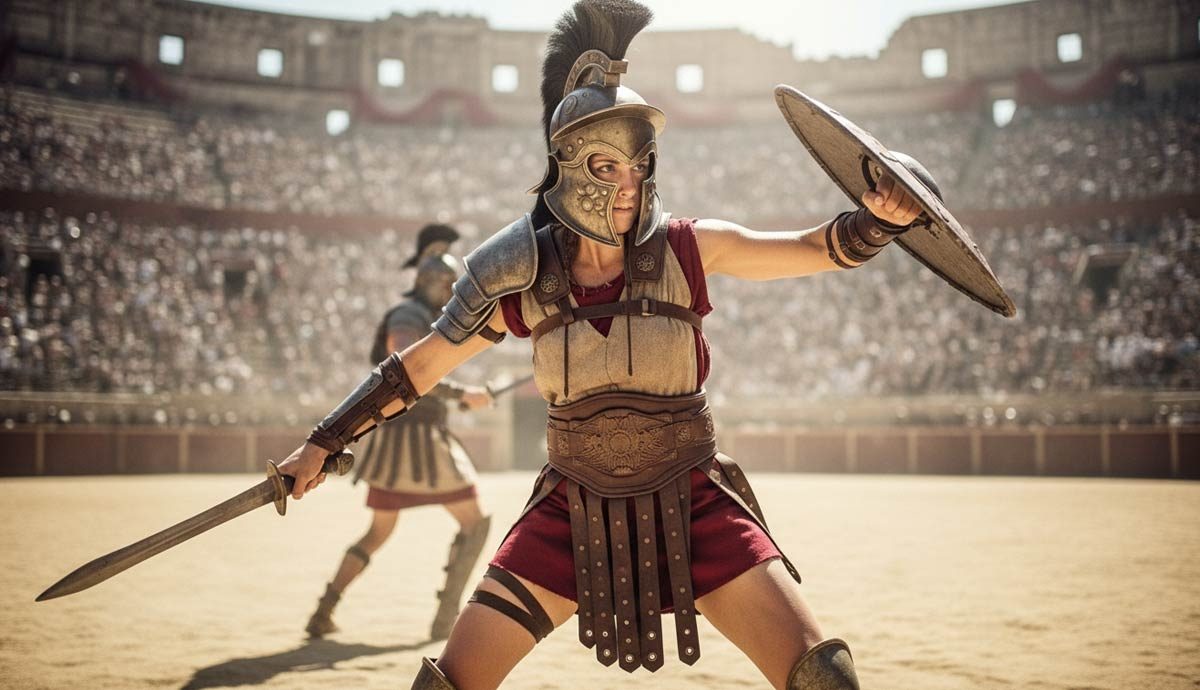
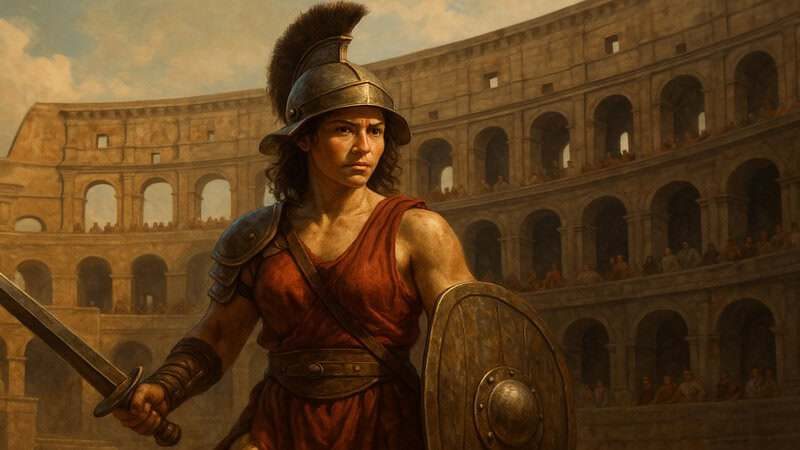
In our own story the protagonist, Scylla, is a woman fighting as a thraex, a Thracian-style gladiator, and everything else grows from that. So we went looking for what history actually says. Were these women a romantic invention or real people? Bearers of glory or slaves at the bottom of the world? After a great deal of reading, the answer turns out to be less simple than either.
1. The real history
In Rome’s enormous surviving literature, the written evidence for women gladiators is scarce. For a long time it was genuinely unclear whether they had existed at all. But several archaeological finds, read alongside the texts, tore open a gap — and through it we can see a rare, brutal and highly professional group of fighters.
2. The Halicarnassus marble relief (1st–2nd century AD)
This relief, excavated in the mid-nineteenth century at Bodrum in Turkey — Halicarnassus in Roman times — moved the gladiatrix out of the realm of imagination. It is now in the British Museum, registration number 1847,0424.19.
The stone is roughly 25 by 30 inches. Two fighters face one another in a wide lunge, each with the left arm thrown back, caught at the moment before the strike. The surface has been worn by two thousand years of weather, but the line of the breast, the curve of the ribs and the hollow above the collarbone are all still legible.
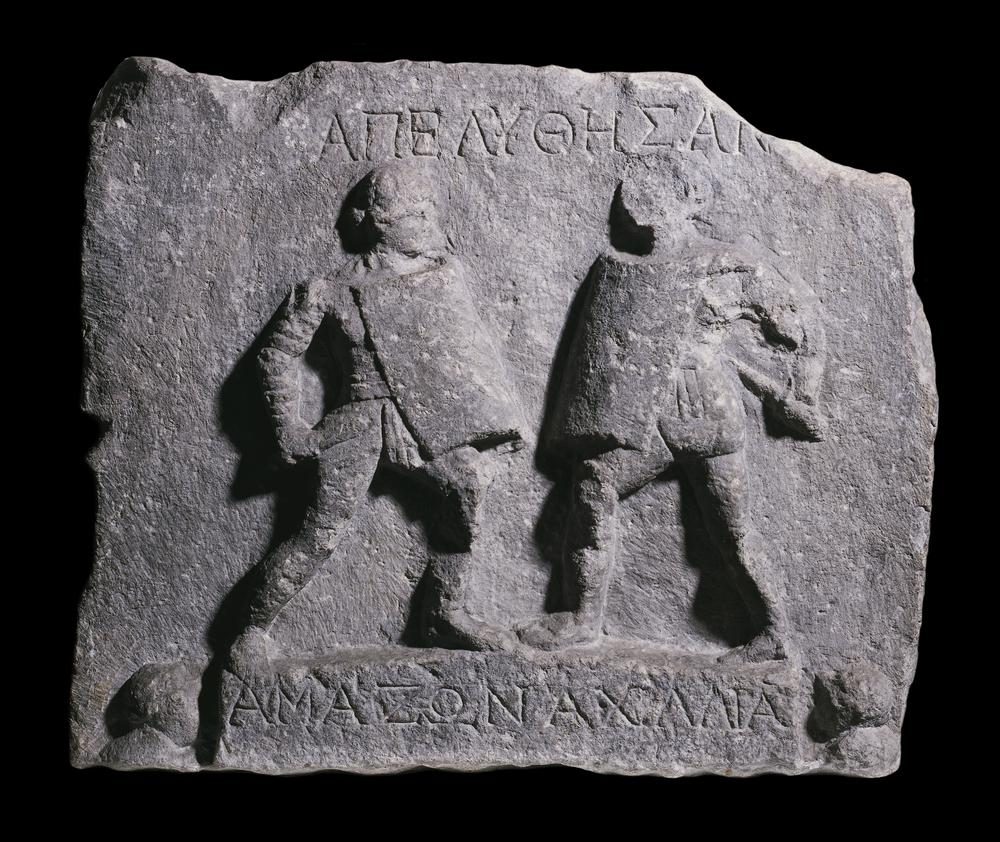
The museum’s own description records it as a marble relief commemorating two female gladiators, Amazonia and Achillia, who were honourably discharged (missio) after fighting to a draw. On the stone they hold sword and shield and are pressing forward, about to attack.
The equipment, read directly off the stone. Their dress and armament are identical to a male gladiator’s, and specifically to the provocator type: a loincloth (subligaculum), greaves, and a manica running from wrist to shoulder on the sword arm, with shield and sword in hand, no helmet and no tunic. The Greek inscription gives their names, which is what puts their sex beyond argument — Amazonia calls up the Amazons of Greek myth, and Achillia is a feminine form of Achilles.
The inscription also records that the bout ended in a draw with both women honourably released. That outcome was rare in Roman combat; it meant the crowd and the sponsor judged both performances worth sparing.
3. The Great Dover Street burial (2nd–early 3rd century AD)
Excavated in 1996 and now held by the Museum of London, this grave at 165 Great Dover Street in Southwark may hold a gladiatrix of some standing.
Museum of London Archaeology found a Roman cemetery during construction work, and one grave quickly drew attention. Forensic examination of the small quantity of cremated bone surviving in the pit — fragments of pelvis — identified a woman in her twenties. The burial is a bustum: the body was cremated directly over the pit, the ash fell into it, and earth was heaped on top. The rite is very rare in Roman Britain, with only around twenty known cases in the whole province, and it was generally reserved for people of consequence.
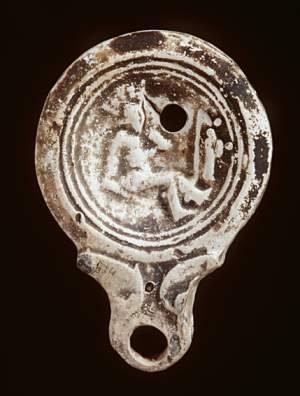
The grave goods point at the arena. What makes this burial contested is the combination: the objects mark out status, and several of them belong to gladiatorial culture — among them lamps decorated with gladiators.
The position of the grave marks an outsider. The cemetery lay outside the wall, which suggests the dead woman had been pushed to the edge of respectable society. That is the puzzle scholars keep returning to: why would a woman buried in the ground reserved for outcasts receive a funeral this elaborate and this expensive? The answer they reach is simple. The woman in that grave was respected but not respectable — which is to say, a gladiator.
4. The bronze statuette in Hamburg (c. 1st century AD)
This figure was only identified as a gladiatrix by a significant reassessment published in 2011. It is held by the Museum für Kunst und Gewerbe in Hamburg.
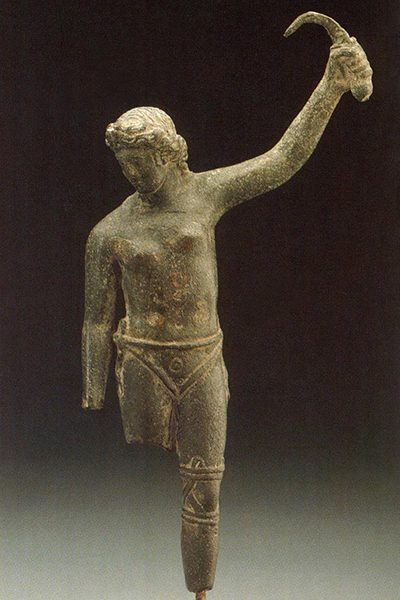
For most of its modern life the two-thousand-year-old bronze was catalogued as a female athlete. It shows a woman raising a curved, sickle-shaped object in her left hand — archaeologists now read it as a sica, the short curved blade carried by the thraex. Her posture is the decisive clue: right arm lifted in a gesture of victory, head turned down as if looking at a defeated opponent on the ground, and her limbs wrapped in fascia, the cloth bindings gladiators wore in training and in the arena. The shape of the blade, the stance and the protective wrappings together are what moved her out of the athletics case.
5. They were professionals, armed as professionals
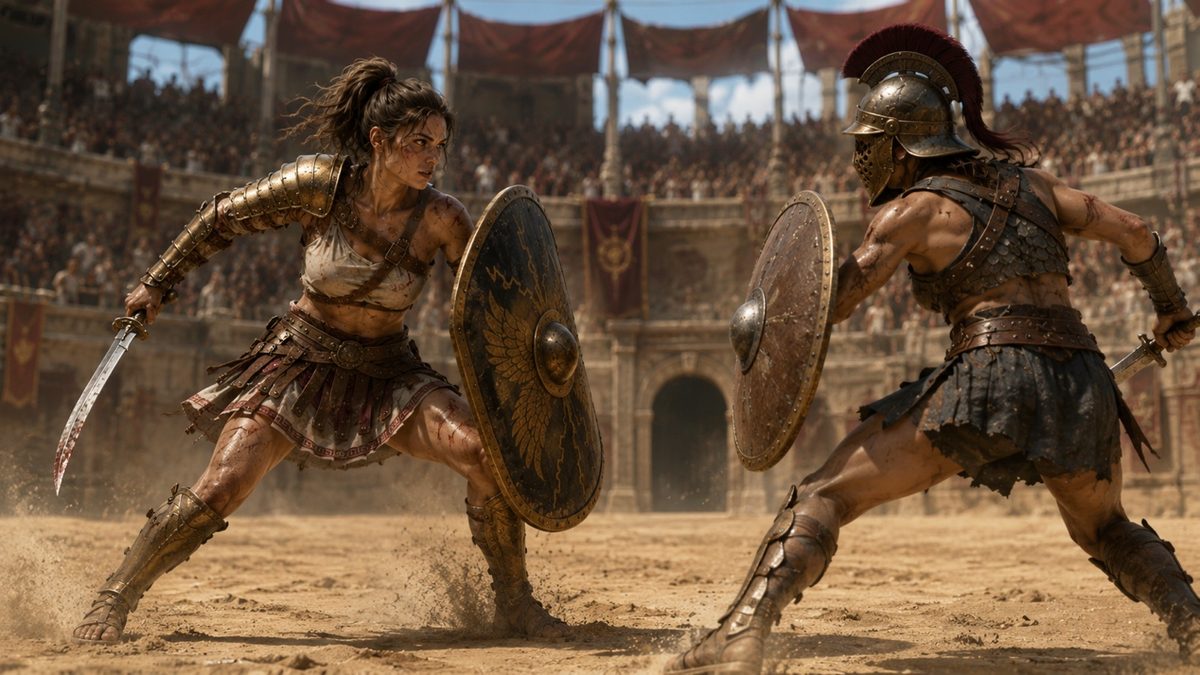
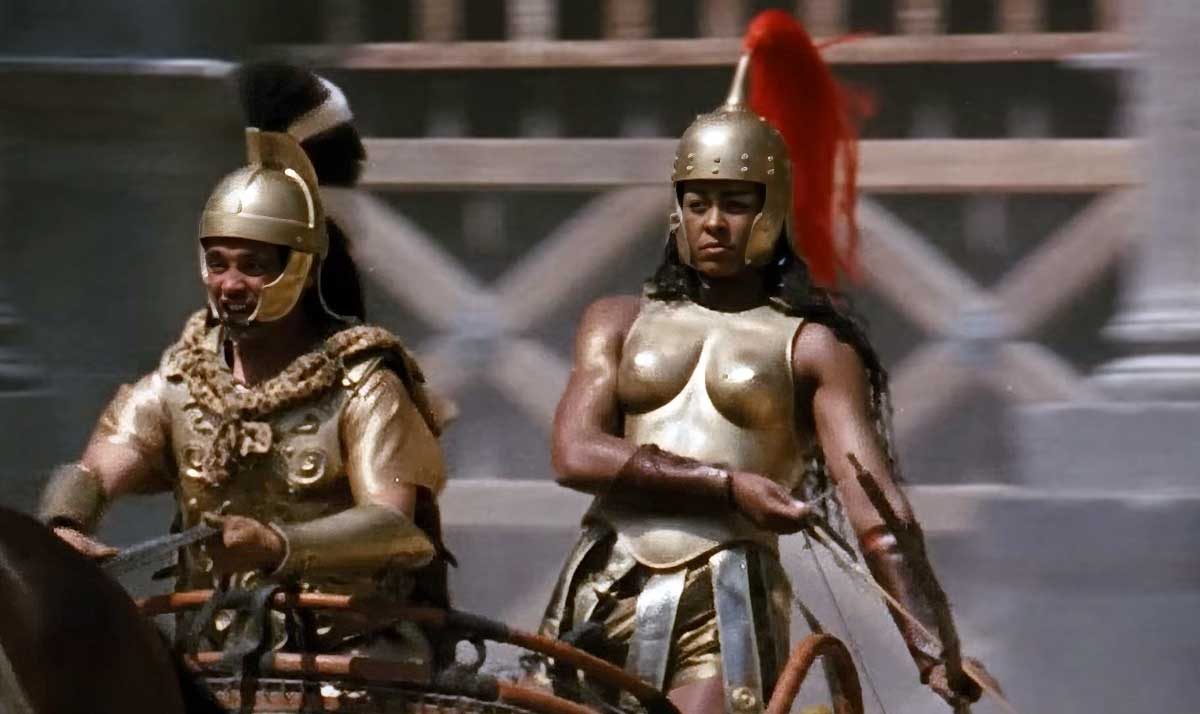
Full heavy equipment. Roman women in the arena were not performers doing a novelty turn. They were often fitted out with complete and specialised heavy gear: the subligaculum at the waist, a heavy bronze belt (balteus), a manica on one arm, a greave (ocrea) on one leg, and the standard Roman short sword (gladius) with the curved rectangular shield (scutum). Some accounts have women fighting from chariots.
Trained inside the regular system. Whatever their origins, these women trained in the gladiator schools (ludi) under doctores and magistri — instructors who were in all likelihood retired fighters themselves.
The law is the best evidence that it crossed class lines. In AD 11 the Senate barred freeborn women under twenty from the arena. In AD 19 the stricter Senatus Consultum from Larinum explicitly forbade the daughters, granddaughters and great-granddaughters of senators from appearing on the stage or in the arena, and extended the same prohibition to women of equestrian families. As a rule, nobody legislates against something that is not happening — a ban is a record of the behaviour it is trying to stop. Around AD 200 Septimius Severus finally prohibited women’s single combat in the arena altogether, and what prompted him was precisely a resurgence of participation by women of high rank.
Why they did it. Women who chose a career in the arena — and it does appear to have been a choice — may have wanted independence, or fame, or money, including money to clear debts. The revealing detail is who Severus was legislating against: freeborn women of good family and comfortable means, women who did not have to enter the arena at all, and who went in anyway rather than live out their lives under supervision.
Afterword
The record of these women is thin. We know they existed, we know they stood in the centre of the arena, and we know crowds cheered for them. Almost everything else is gone.
Amazonia and Achillia are the case in point. Two thousand years ago someone cut their names into a slab of stone. We know they fought each other and we know the fight ended even. Where they came from, what they had lived through, how they ended — for all of that, history has nothing to say.
Scylla was born in that silence. We wanted to imagine whether, after the duel history bothered to record, there might have been another story nobody wrote down.
Background to the fiction
This note is research for the original novel Death of a Gladiatrix. Set in Trajan-era Rome, it turns on the death of one woman fighter and opens into five acts on imperial order, collapsing faith and the fate of women. The Chinese original of this article is at 沙地舞者:古罗马的女角斗士.