The Iron Women Behind the Industrial Revolution
In the pits, picking sheds and canal banks of nineteenth-century Europe, working women in Britain, Belgium, France and Spain carried the Industrial Revolution on their bodies. Research for Bread and Roses.
Say nineteenth-century European women and the historical filter usually adds a layer of lace: corsets, parasols, afternoon tea, delicate nerves fainting in a drawing room.
At the same moment, underneath Europe — hundreds of metres down in the pits, in the roaring picking sheds, on the muddy banks of the canals — another group of women was rebuilding the skeleton of the world.
No one painted fine portraits of them. But the gears of British and continental heavy industry meshed and turned on their calloused hands and their extraordinary physical strength.
Turn over these few coal-black slices of the record and a very different nineteenth century appears, one driven by women’s labour.
These women were the stressed syllable of their age, buried under coal dust — the black spine that actually held the period up. And some of what happened reads like fiction.
1. Wigan, England: the Pit Brow Lasses in trousers, defending their jobs
“Respectability will not keep you alive. What we want is the right to work.”
Women had worked in European mining since the Middle Ages, and around Wigan in particular there was a long-established group of women in the industry known as the Pit Brow Lasses.
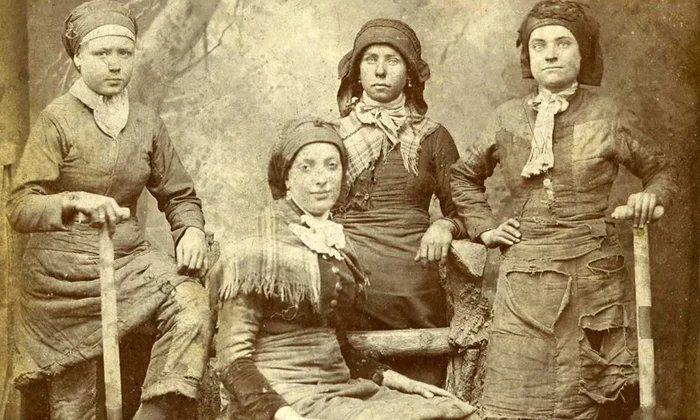
From the Guardian, “Why ‘pit brow lasses’ were coal mining’s unsung heroines”
The new Mines Act. Until 1842, women and children as young as eight worked underground. Having seen the conditions, Britain’s response was not to improve them but to ban women and children from going below, for their protection.
The contradiction. Large numbers of women moved to surface work, sorting coal, which was brutally heavy. To work in it they rolled up their skirts or simply wore coarse trousers underneath, and this set off an enormous moral panic.
Trousers or a living. In 1886 these workers took a third option. They turned up in their distinctive pit trousers and clogs to confront the guardians of public morals, and by standing there as what they actually were — workers — broke the hypocritical gaze and kept their jobs.
History has its surprises. More than a century ago, a pair of trousers tore open a question, in the most conservative period available, about how a woman should dress and how she should live.
2. The Borinage, Belgium: pushing a tonne of coal to the surface by hand
“They did not need protecting. They were the force itself.”
While Britain was legislating women out of the pits on grounds of decency, in the Belgian coalfield of the later nineteenth century the women who pushed the coal carts — the hiercheuses — stood at the visual centre of heavy industry.
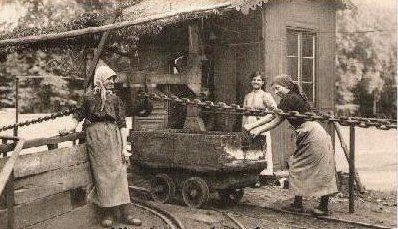
Pure physical labour. There was no technique involved; it was straightforward extraction from the body. In dark, cramped galleries where you could not stand upright, women in coarse trousers, barefoot or in clogs, pushed carts loaded with 800 to 1,000 kilograms of coal several kilometres along the rails every day.
Van Gogh’s record. Being recorded in paint was, at the time, essentially an aristocratic privilege — but some equally poor painters chose to use the brush on ordinary people. To the young Van Gogh these were not pitiable victims but workers full of vitality, with the musculature of bronze sculpture. So he drew them.
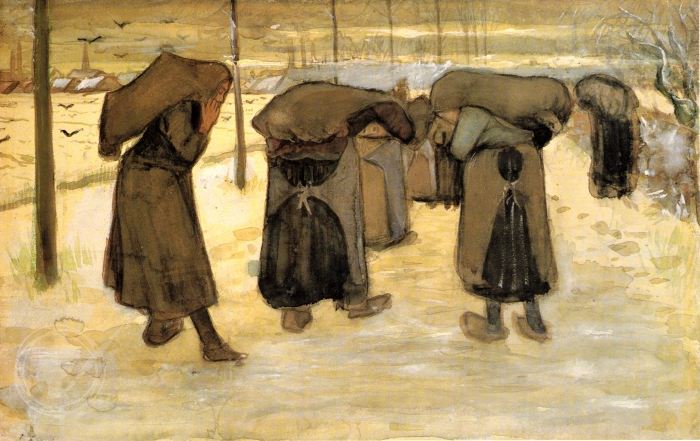
Women Miners Carrying Coal, Van Gogh, 1882
Enormous physical output bought unusual power. They were paid piece rates close to the men’s. After a shift they washed the coal off and walked into the bar and drank strong dark beer the way the men did.
In a period when the overwhelming majority of women had no control over property at all, the Belgian cart-pushers hammered out economic independence in an extremely hard-edged way.
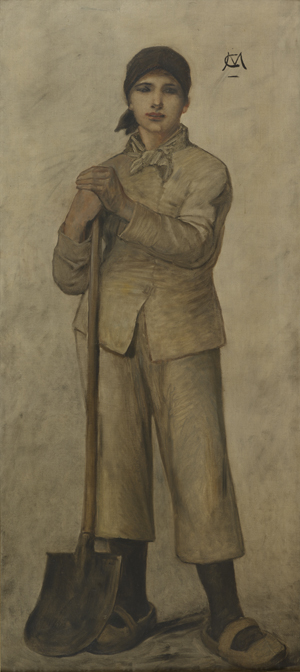
Constantin Meunier, Hiercheuse (c. 1882–1884)
3. The northern French coalfield: black hands on the line, and the most disciplined picket
“The hands that can sort ore can also close precisely around capital’s throat.”
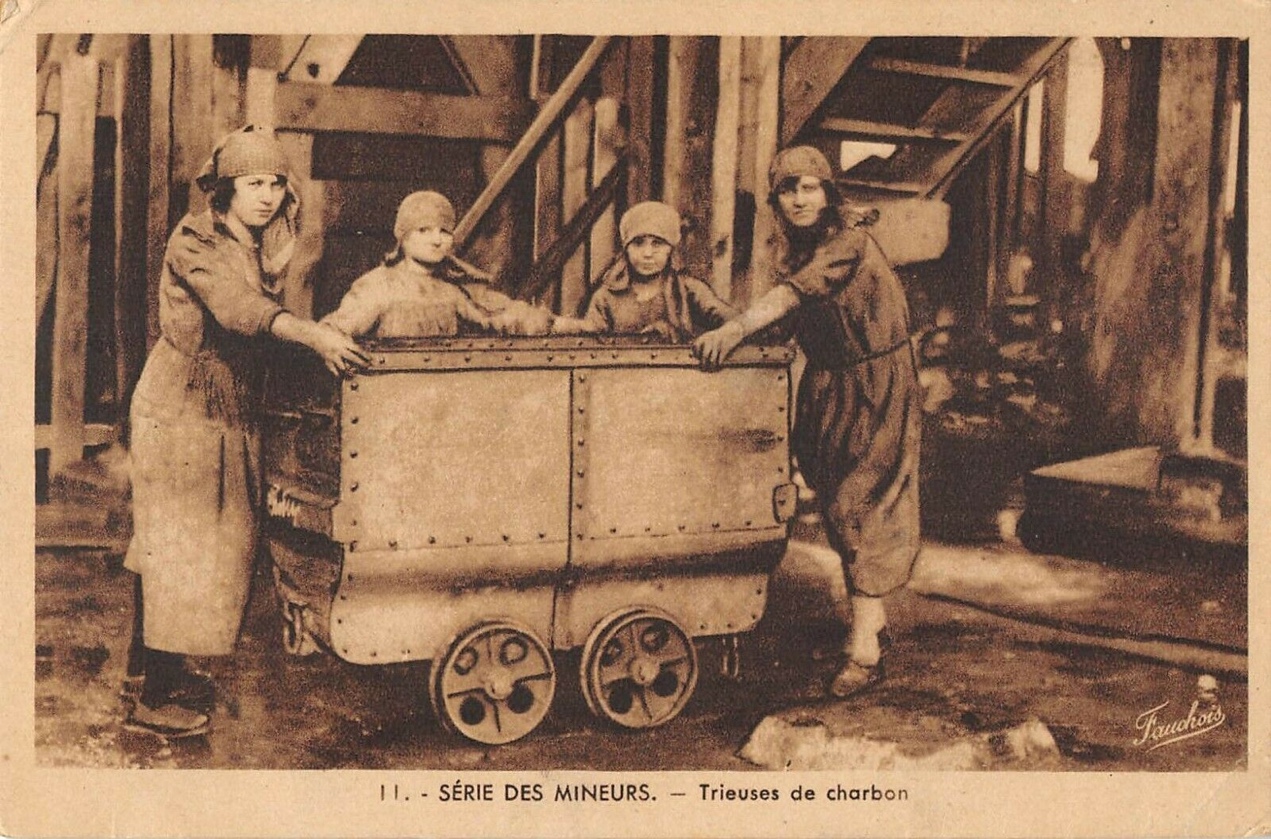
Up out of the ground, at the surface of the Anzin field in France, the battlefield belonged to the women sorting coal, the trieuses de charbon.
Underrated skill. History usually files women’s sorting work under simple odd jobs. In fact, separating waste rock from coal at speed in front of a moving belt takes remarkable eyesight, reaction time and two-handed coordination.
A community under punishing conditions. In the deafening noise of the machinery they could not talk, and worked by glance and gesture. Their fingers bled and callused year-round. In front of that belt they built an efficient industrial line of their own.
The last line of support. In the miners’ protests that swept France in 1884 — the historical basis for Zola’s Germinal — mining families faced being starved out. It was the women who took over the entire logistics of survival, setting up communal kitchens and rationing food.
They then went into the streets themselves, in heavy wooden clogs, beating pots and pans into a deafening rhythm to block strikebreakers from entering the pit and protect what the workers had won.
It is exactly this invisible, forgotten work that bought the conditions we now live in. Without it humanity might genuinely not have found its way out of the nineteenth-century factory.
4. Bilbao, Spain: rope cutting into flesh, and an artery brought to a stop
“When they put the ropes down, what happened next reads like a novel.”
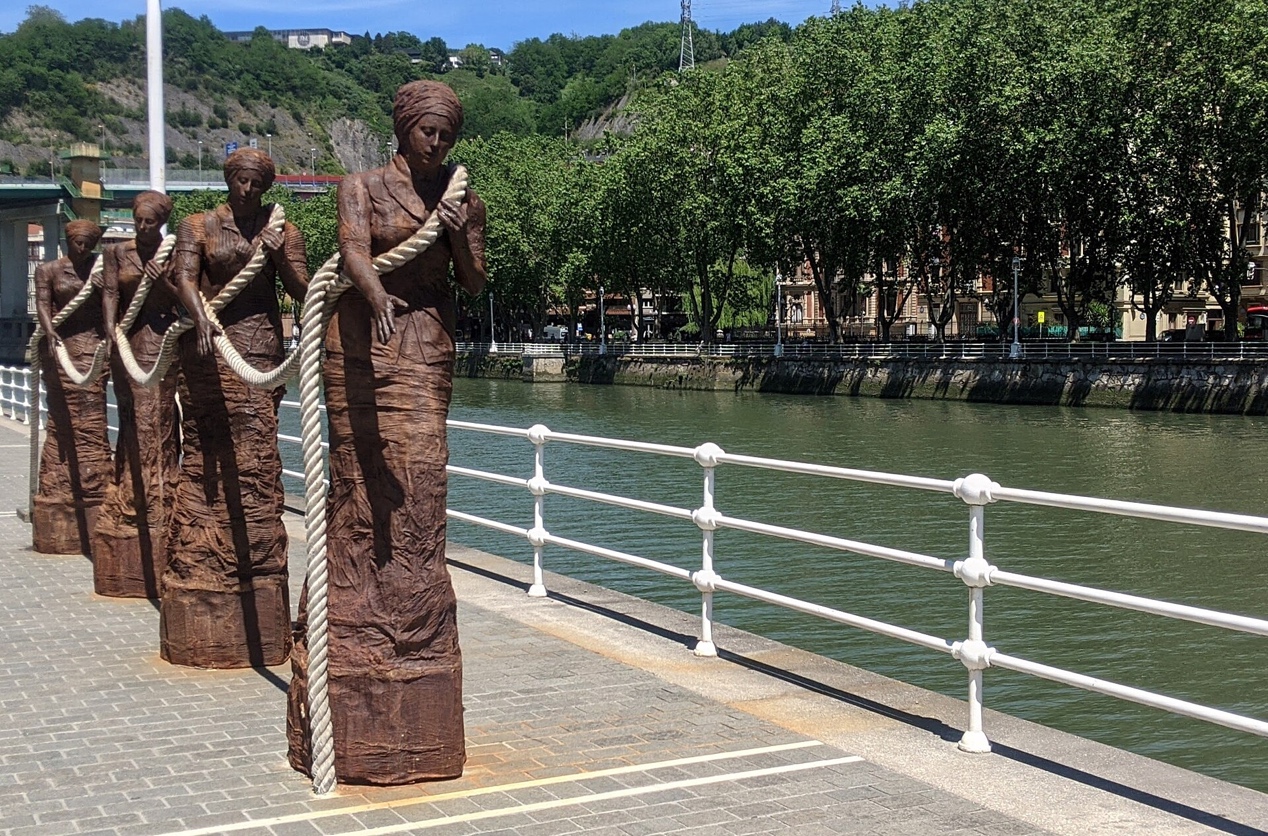
Turn to northern Spain at the end of the nineteenth century, which produced the best iron ore in Europe. On the canals at Bilbao there was a particular group of women known as las sirgueras — the women who hauled the barges.
Women as haulers. To save the cost of horses or steam tugs, the mine owners hired women to tow.
The sight of it is startling: dozens of women with coarse rope pulled tight across the chest or the waist, bodies pitched forward almost to the ground, dragging heavily loaded barges carrying hundreds of tonnes of iron ore step by step along a muddy bank.
The rope cut deep bloody grooves into their shoulders. But that rope was both the oppression and the leverage. Capital squeezed all the way down the chain from the great ore mountains to the women on the waterway.
In 1890 the line, stretched to its limit, finally broke. What followed reads like fiction.
The miners put down their hammers, the haulers put down their ropes, and the whole mining industry of northern Spain came to a halt. The mining magnates arrogantly called in the imperial army to suppress it — and General Loma, the commander sent to do the suppressing, having seen with his own eyes the animal conditions the miners and the haulers were living in, was enraged by the owners’ greed.
The general with the troops turned the pressure the other way, using hard military administration against the mine owners and ordering the worst of the exploitative arrangements abolished immediately.
This time the magnates not only had to bow, but had to bow to the cheap labour they despised most, and to the army they had summoned themselves.
In 2021 Bilbao erected a sculpture by Dora Salazar near the estuary in memory of these women.
Afterword
Ask what they left behind.
The women of the nineteenth-century mines left no great names in the textbooks. But every part of the way we live now carries their shadow; their sweat was poured into the rails of Europe’s railways and the boilers of its factories.
What they left the world is not only the primitive capital accumulation of the Industrial Revolution. It is a piece of hard evidence driven home with the body: that a woman’s body can carry extreme weight, that a woman’s will can hold up a life that hard, and that women are willing to give their hearts to something larger than themselves.
With rough hands, underground and covered in coal smoke, they dug the first passage toward modern labour rights and the right of women to work.
So even if history was in too much of a hurry to remember them, we can dig up a little of the memory. And our own novel Bread and Roses is an attempt at exactly that — if history forgot them, at least we have not.
Background to the fiction
This note is research for the original novel Bread and Roses, set in the South Wales coalfield in 1910. The Chinese original of this article is at 工业革命背后,那些钢铁女性.